‘Dad, who is Satan?’

'Dad, who is Satan?'Teaching kids the basics about God can be easy—at least compared to other subjects.

For instance, even a young toddler quickly can learn the answer to “Who made you?” And after that, they just as easily can learn the answer to two related questions: “What else did God make?” (Everything.) “Why did God make you?” (For His glory.)

But if you raise children to think biblically and even theologically, pretty soon they’ll toss a curve ball your way and you’ll be left speechless, not sure how to respond in simple, kid-level language.

“Dad, who is Satan?” my 3-year-old son asked a few weeks back.

I know the “adult answer.” But the “kid-level answer”? I was speechless.

No doubt, my son knew Satan was bad—his books and DVDs certainly implied that—but that only got him so far. That’s because we’ve taught him that a lot of people in the world are bad and that there are “mean people” who would harm him. Satan, though, is far, far worse than your everyday “bad” person. And he’s technically not even a person. So what do you say?

My first answer? “He’s the embodiment of evil.” Thankfully, my wife intervened and gave me some tips—well before I confused my son. And then I read my favorite theological resource (Wayne Grudem’s “Systematic Theology”), added some verses, and boiled it down to four points to share with my son:
Continue reading

New Horizons, Pluto and God: 3 lessons that will blow your mind

New Horizons, Pluto and 3 awe-inspiring lessons about God

Artist’s concept. Source: NASA

One of my favorite magazines is National Geographic, which may seem kind of odd coming from someone who holds a worldview quite different from that of the award-winning publication.

But while National Geographic may be void of explicit Christian or even theistic commentary, each month it does a stellar job in showcasing the wonders of God through its pictures, illustrations and text – even if the editors and writers don’t realize it.

God wants us to marvel at His creation, but in the irony of ironies, it’s often the naturalists who spend the most time doing it. Too often we Christians distance ourselves from science, viewing it perhaps as boring or even at war with Scripture.

The biblical writers didn’t see it that way. In fact, if you look at only one aspect of science – astronomy – the writers of the Old and New Testaments spent a great deal of time thinking about it. The Bible mentions stars more than 40 times, such as: “He determines the number of the stars; he gives to all of them their names” (Psalm 147:4). Or this one: “By the word of the Lord the heavens were made, and by the breath of his mouth all their host” (Psalm 33:6).

In case you haven’t heard, this month we’ll get our first-ever look at Pluto, that tiny body in our solar system that was discovered in 1930 but is so far away that it merely looks like a speck of light through telescopes. If you’re of a certain age, it was the ninth planet for decades and decades before (wrongly) being demoted to “dwarf planet” status.

NASA in 2006 launched a piano-sized spacecraft called New Horizons, which has taken nine years to trek 3 billion miles even though it is traveling at 38,000 mph. National Geographic writers, though, shouldn’t be the only ones fascinated with this mission. God’s people should be at the forefront. In fact, if Abraham, King David and even the Apostle Paul were alive, I think they would be gathering around computer screens, waiting for the latest images of Pluto to display.

Here are three lessons about God we can learn from the New Horizons mission – and can teach our children:
Continue reading

6 reasons our society still needs dads

6 reasons our society still needs dadsThere’s a river about half a mile from my house that my 7-year-old son and I enjoy. We hunt for fossils, skip rocks off the water, and watch boats speed along. Every now and then, we even catch a beautiful sunset.

It’s a perfect father-son destination and brings back memories of that opening tranquil scene in “The Andy Griffith Show”— minus the whistling, of course. But on one recent afternoon, my son did something that could have been set in fictitious Mayberry.

He picked up a stick and was writing in the sand, shielding his creation from my eyes.

“Don’t look,” he demanded.

A few seconds later, he asked me to turn around.

“I love Daddy,” it read.

It was one of those “awww” moments that every parent has, the kind you want to bottle. But on this night—after he went to bed—I began thinking not about him or me but about our society. According to the National Fatherhood Initiative, one-third of all children in America live in a home without their biological father. Meanwhile, we are in the midst of a great cultural debate over whether children need both a mother and a father.

No doubt, there are heroic single mothers who do an amazing job and overcome obstacles every hour of every day, but what is the ideal?

Fathers, it turns out, are still needed, despite what culture may say. Why would God require both genders to make a child, but not to raise the child? Yes, God has gifted moms and dads in unique and complementary ways.

With a hat tip to sociologist W. Bradford Wilcox’s excellent research for points 4 to 6, let’s look at why kids still need dads:
Continue reading

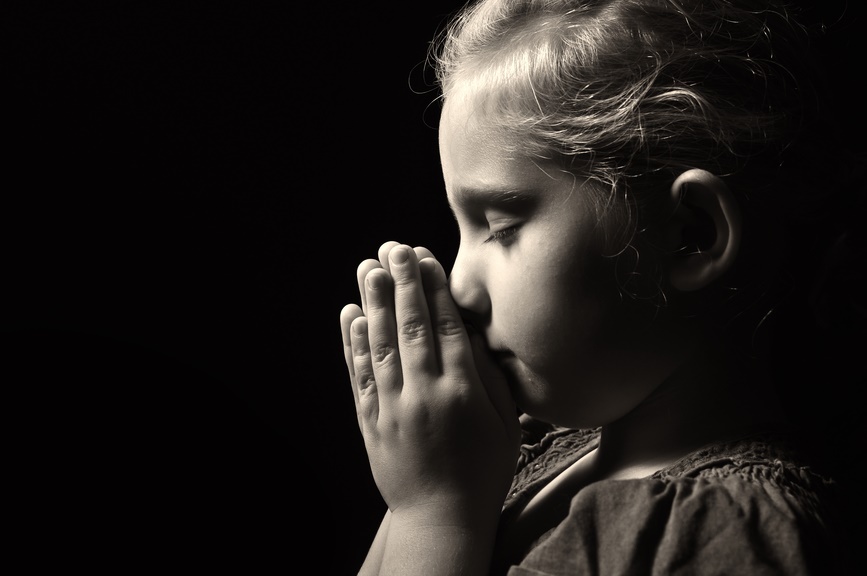
3 simple and easy ways to teach your kids to pray

3 simple and easy ways to teach your kids to prayChildren were a focus of Jesus’ ministry. He used the loaves and fish from a boy to feed the 5,000. He healed at least one sick child and raised another one from the dead. He told his followers to have the humility of a child. He even took children into his arms and blessed them when his disciples wanted to send them away.

I think about Jesus’ view of children often when my three children pray some of the most heartfelt, inspiring and even entertaining prayers I’ll ever hear.

Consider, for example, my oldest son’s prayers when he was 3.

When I told him we should thank God for everything in life, he took it seriously, even providing God plenty of detail.

“God, thank you for my train table and those two plates on the wall that are next to the smoke alarm,” he said one night while lying in bed, describing two colorful ceramic birthday plates that, yes, were right next to the smoke detector in his bedroom.

On other nights, he felt a bit more academic.

“God, thank you for the letter B, the letter D, and the number 3.”

And on some nights, he was feeling a bit theological.

“God, thank you for crushing Satan’s power,” he said, quoting, verbatim, what he had read in one of his storybook Bibles.

But there are plenty of times in which my children refuse to pray—when we go around the table at suppertime, finding no volunteers. Just like me, and perhaps you, too, they can be stubborn when facing spiritual matters. If we want our children to pray, we ourselves must first believe in the power of prayer (James 4:2-3)—and then set the example.

Here are three specific ways to do that:
Continue reading

4 keys to raising selfless kids

4 keys to raising selfless kidsMy youngest son is 3 years old, and he, like all of us, struggles to put others first. His selfish moments, though, tend to be louder—and at the same time, funnier.

For example, there was the moment a few months ago when he was having an extra-difficult time playing with his twin sister. My wife had taught him to treat girls with respect and kindness, and even had taught him to be a “gentleman”—a word that I reminded him of that afternoon when he and his sister were fighting over a toy.

“But I don’t want to be a gentleman!” he screamed to no one in particular, tugging even harder at that toy, determined to get it back.

He was perfectly fine with the death of chivalry that afternoon, as long as he got his way.

Of course, it wasn’t the first time that he had exhibited a stubborn streak of selfishness, nor is he alone. His sister often is the instigator, and if not her, it’s her 7-year-old brother.

Young couples who deny the doctrine of original sin get a wake-up call when they have their first child. A baby’s first words often are, in order, “da-da” and “ma-ma,” followed quickly by “no!” and then “mine!”

Children aren’t taught to be selfish. It comes naturally—and then tugs at each of us every day throughout adulthood until we breathe our last breath.

We can teach our children to be unselfish while learning valuable lessons ourselves. Here are four ideas:
Continue reading