REVIEW: Is ‘Jack Reacher: Never Go Back’ family-friendly? (And is there too much violence for kids?)

REVIEW: Is 'Jack Reacher: Never Go Back' family-friendly? (And is there too much violence for kids?)If you ever decide to venture into a dark alley, late at night with bad guys all around, then you might want to take Jack Reacher with you.

Reacher is the hero in the popular book series by Lee Child and the film series starring Tom Cruise, and it seems there’s nothing he can’t escape. Sure, he might kill a few people and break a few necks along the way, but the odds are that he’s walking out alive.

Jack Reacher: Never Go Back (PG-13) hits theaters this weekend, bringing us the second installment in the movie series that follows a former major in the U.S. Army Military Police Corps who travels the country and constantly finds himself in the middle of trouble. But somehow, he always ends up on the right side of things.

He’s part James Bond, part Jason Bourne and part Ethan Hunt – and 100 percent testosterone.

In the newest movie, Reacher (Cruise) is framed for murder and his friend Major Susan Turner (Cobie Smulders) is wrongly accused of espionage, but both escape custody (thanks to Reacher) and begin trying to find the people who truly were responsible for the crimes.

It won’t be easy, though. They’re not only being chased by military police but also by the bad guys – the bad guys who actually did commit the crimes. And those bad guys not only want Reacher and Turner dead, but they’re also after a girl, 15-year-old Samantha (Danika Yarosh), who is believed to be a daughter that Reacher never knew.

There are 20 books in the Jack Reacher series, so there’s a good chance we’ll be seeing this character for many years to come on the big screen.

But is Jack Reacher: Never Go Back family-friendly? Let’s take a look. Continue reading

‘Dad, what’s wrong with her?’ (4 things to teach your kids about disabilities)

‘Dad, what’s wrong with her?’ (4 things to teach your kids about disabilities)

My oldest son was munching on French fries and looking around the restaurant, as the rest of our family finished a meal on a lazy Saturday afternoon.

His mind, though, was not on the topic of conversation. Instead, he was staring at an adjacent table, where another family was sitting.

“Dad, what’s wrong with her?”

Almost immediately, I knew what he was referencing. Sitting at the table was a woman in a wheelchair, maybe in her 20s, who was mentally disabled. Every now and then she would look our way and smile, and I would smile back, but my son – who at the time was in the second grade – did not know what to do.

“She keeps looking over here, Dad.”

My son was confused, not knowing what to think, and I was searching for answers. And I knew that this conversation would apply to every area of his life.

No matter where he goes – to school, to church and (one day) to work – he will encounter people who look different, sound different and act different. His friends might be tempted to say “she looks weird” or “he acts goofy,” but I pray he will respond with the heart of Christ, and not with the words of a bully.

After all, the entire point of the Gospel was to help those who are helpless. Sure, the core of it was Jesus saving sinners, but if we study His life on this earth, we discover He had a heart for the disabled: the leper, the blind man, the lame person. And what about the story of Zacchaeus (a despised tax collector who was so short he couldn’t see over anyone) or even Paul (who had an undefined “thorn in the flesh”)?

If my son gets this lesson right early in life, then he will have the courage to stand up for the humanity of the mentally disabled woman in the restaurant … or even the skinny, acne-prone boy in science class.

As we walked away from that restaurant, I made several points: Continue reading

REVIEW: Is ‘Miss Peregrine’s Home For Peculiar Children’ too scary for kids?

REVIEW: Is 'Miss Peregrine's Home For Peculiar Children' too scary for kids?Emma is a girl who is lighter than air, and if she doesn’t wear lead shoes, she will simply float away. Bronwyn, who lives in the same house, has the strength of 10 men. Another girl, Fiona, can make plants grow in mere seconds. Then there’s Hugh, a boy who has bees living in his stomach, and Horace, who has a magical eyeball that acts as a projector, allowing him to “play” his dreams on the big screen.

Such is the life for the kids in Miss Peregrine’s Home for Peculiar Children (PG-13), which opens this weekend and is the latest quirky movie from director Tim Burton, who also gave us Charlie and the Chocolate Factory and Alice in Wonderland. But unlike those two PG-rated films, this one delivers enough creepiness and scary moments that parents might want to think twice about taking young children. (More on that in a bit.)

Miss Peregrine’s is based on the bestselling book by Ransom Riggs and follows the story of World War II-era kids who live in a children’s home because they all have peculiarities due to a recessive gene. Their headmistress is Miss Peregrine (Eva Green), who has the ability to transform into a peregrine falcon.

If all of that wasn’t weird enough, they’re also stuck in a time loop and seem destined to live forever on one date: Sept. 3, 1943 – the day Nazis bombed the house. Each night, before the bomb crashes into the home, Miss Peregrine turns her watch backwards, reversing time.

The children desire a more normal life, and they find hope when a seemingly ordinary teenage boy — Jake (Asa Butterfield) – finds the home. His grandfather, who fought in World War II, had told him stories about the house and its occupants.

No doubt, many children will be asking their parents to watch Miss Peregrine’s this weekend, but what is the appropriate age for a kid to see this one? Let’s take a look … Continue reading

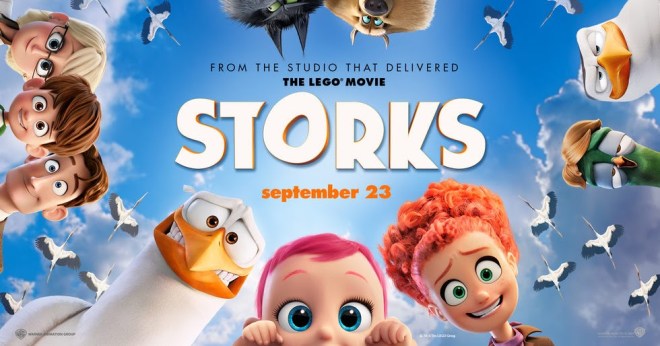
REVIEW: Is ‘Storks’ OK for small kids? (And are there any scary parts?)

REVIEW: Is 'Storks' OK for small children? (And are there any scary parts?)Nate is an energetic, creative little boy who wants a sibling – specifically, a brother – so he can have a playmate. His parents, though, are workaholic realtors who can’t fathom a household with two children.

But Nate has a grand idea. He will send a handwritten letter to the storks, who live far, far away on Stork Mountain, and they will bring him a brother. There’s one big problem: The storks are no longer in the baby business. (Yes, they once were.) They are now an Amazon.com-type company known as Cornerstore.com, and they deliver packages – such as TV sets.

Fear not, though, because the letter ends up in the hands of a clueless company worker, who accidentally turns on the non-operational baby-making machine, popping out a sweet little bundle of joy. So far, so good, but the CEO of Cornerstone, Hunter (Kelsey Grammer) vows to stop the delivery, and a pack of wolves wants the baby, too.

It’s all part of the plot in Storks (PG), which opens in theaters this weekend and was created by the same studio (Warner Bros. Animation) that gave us The Lego Movie, which was No. 1 for three weeks in 2014 and ended with an incredible $257 million domestic gross. I really liked The Lego Movie, but I enjoyed Storks even more. Storks is funnier, has a better storyline, and also has more life lessons for children and parents.

Storks is pro-family in the original sense, and after watching it you understand why an adoption organization (adoption-share.com) is one of the film’s partners.

But is Storks OK for all children, including small kids? Let’s take a look. Continue reading
‘Dad, what is abortion?’ (4 ways to discuss society’s most-debated issue)

‘Dad, what is abortion?’ (4 ways to discuss society's most-debated issue)

As a parent, you don’t always get to pick the perfect moments for discussing life’s big issues with your children. In fact, sometimes they take place at the absolute worst times — like on a Sunday morning, when you and your spouse are frantically trying to get all the kids ready for church.

But that was the situation I found myself in recently when my 8-year-old son, in between brushing his teeth and combing his hair, broached the issue of politics, boldly declaring who he was for in a major election.

“And that’s who my friends are for, too,” he said.

His choice, though, was not my choice, and it boiled down to one issue: abortion. I have never supported a candidate who backed abortion rights, and this race was no different.

“What is abortion?” he replied.

Perhaps my son’s naive political position was my own fault. I enjoy talking about government and politics with my kids: We’ve toured presidential historical homes (so far, four as a family) and we’ve attended campaign rallies (of both major parties).

It’s been sort of a Civics 101 lesson for my kids, yet I’ve never gone into detail about why Mommy and Daddy support one candidate and not the other. It’s always been a generic “we’re not for them because they believe things that go against the Bible.”

Yet here I was, on a stressful Sunday morning, wondering if it was possible to explain the most divisive and debated issue of our time to my 8-year-old son … and preferably in less than three minutes.

Of course, a conversation about abortion will look different within different families, but most of them – within a pro-life framework – will share similar points. Here are four suggestions: Continue reading